


Nov 10 2014
Fracking Victories and Defeats Provide Lessons in Organizing
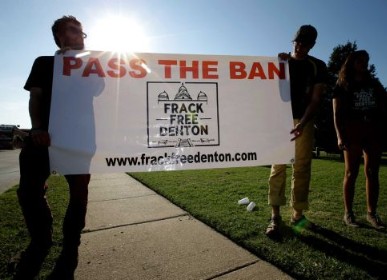 Something unbelievable happened last week in the oil and gas soaked state of Texas. Residents of Denton voted to ban fracking in their town which lies on the edge of the Barnett Shale. Although 270 gas wells already spot its neighborhoods, the fracking ban garnered 59% of Denton’s vote. Chevron, Occidental Petroleum and a number of other companies spent 10 times what fracking opponents spent leading up to the election to defeat the measure. Now, those companies are gathering their forces to fight the ban in court.
In Illinois however, oil and gas companies are celebrating. The Illinois state government, with no public consultation, approved fracking rules and cleared the way for companies to apply for permits in a 15 minute closed-door meeting last Thursday. Oil and gas companies will now be able to start setting up operations in Illinois 30 days after paying a fee of only $13,500.
But communities around the nation like Denton, Texas, are standing up to oil companies and instituting fracking bans. Last week’s elections had a record number of eight fracking bans on the ballot and 4 of them succeeded. Along with Texas, residents of Athens Ohio, and the California counties of San Benito and Mendocino approved bans in their communities.
GUEST: Jeff Biggers, award winning journalist and author of State Out of the Union, Reckoning at Eagle Creek, The United States of Appalachia and In the Sierra Madre
One Response to “Fracking Victories and Defeats Provide Lessons in Organizing”

Regarding Illinois: Facts matter.
1) “No public consultation” Really? There were five public hearings. As Mr. Biggers acknowledged, there were over 30,000 public comments submitted and reviewed by the state agency writing the regulations. The law was passed and signed by the Governor in June, 2013, and it took until this past week for the rules to be finalized. There was a first draft in November, 2013. There was a second draft in August, 2014. And now, in November of 2014, a final revision has been adopted. That, to me, was a very deliberative process.
2) You fail to mention that in March of this year, there was an expression of public will, in the form of an election, in one of the counties that might be affected. That ballot measure to prevent hydraulic fracturing was defeated by a margin of 58 percent to 42 percent.
3) “Closed door meeting” Really? Ann Alexander of NRDC was in the room. So was the Chicago Tribune. So were many others.
4) In the election last week, the voters had the choice to re-elect a sitting Democrat or a Republican challenger. The Republican, who stated in his campaign stump speech that he supported hydraulic fracturing, garnered 86 percent of the vote in my home county; this is the southeastern Illinois county that is at the heart of the leasing and potential hydraulic fracturing activity.
5) This is an area with a long history of oil production, dating back to the 1930s.
6) In this area, willing buyers (oil companies that are offering leases), willing sellers (land holders who sign the leases and are compensated for them) and a willing labor force are all eager to get started.
7) If you do the math, you will see that we will be using significant amounts of fossil fuels for at least the next 50 years. That takes into consideration the widespread development of alternatives. Wishful thinking will not allow us to avoid that fact. If that is the case, then I would prefer that our fossil fuel source be on-shore, mid-continent oil and gas production rather than strip-mining for coal or oil sands, or drilling in the Arctic Ocean, or importing from foreign countries that hate us.